
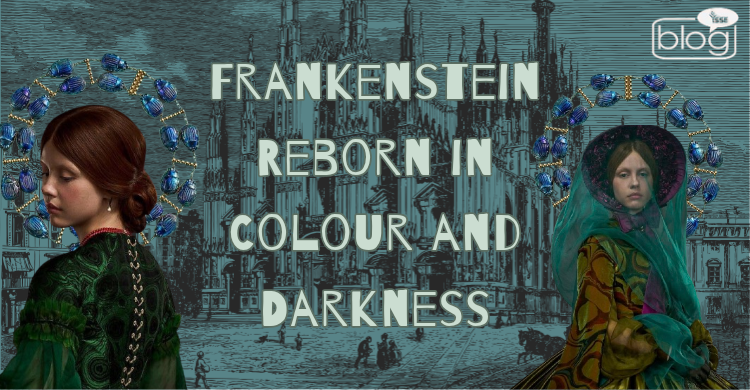
“When does a man become a monster?” This famous question from the “Epic” musical seems to be what Del Toro was attempting to answer in his newest adaptation of Mary Shelley’s Frankenstein. In its recent limited release at the Venice International Film Festival, Del Toro’s Frankenstein has proven itself to be the perfect balance of the gothic romanticism of Crimson Peak (2015) and the dark fantasy of Pan’s Labyrinth (2006). The Oscar-winning director Guillermo Del Toro reimagines the 1818 Gothic novel “Frankenstein; or, The Modern Prometheus” in the backdrop of the Crimean War in the mid-1800s, choosing to focus on the irony of creating life in the midst of death in Europe. As with any movie by the director, he hypnotizes the audience with a dash of vibrant color play in the otherwise bleak screen full of cold and melancholic blues and blacks. Del Toro, alongside costume designer Kate Hawley, uses colors, patterns, and jewelry to tell his story. The timeless tale of a man creating a monster and a monster becoming a man finds a new life in the hands of the maestro himself. Mary Shelley may have written the story of a man playing God but Del Toro showed us the consequences of it. Let us look at just how intricately he crafts every detail.
Blood Red
Red is undoubtedly Victor’s colour- a theme that continues throughout Victor’s childhood memories. From his cravat to his gloves, Oscar Isaac as Victor is the only one consistently wearing blood red, reminiscent of his late mother’s flowy dresses and the color of his lost childhood. Bright vermillion is the color of the coffin in which his mother rests forever. The scarlet St Micheal statue in his room quickly transforms into the sinister Dark Angel in his dreams, promising him power over life and death. His crimson gloves mimic bloody hands, an ode to his attempt at creating life.
Viridescent Green
Next comes Elizabeth with her tones of green, played by the scream queen of this generation, Mia Goth. She is the opposite of Victor with her love of insects, especially beetles, and all things natural. Elizabeth’s vibrant dresses are crafted to be flowy and always moving along the young girl, full of life. The Malachite-inspired patterns of her dress tie the character’s fascination with natural life. Almost always, her dresses have an iridescent golden effect akin to various species of beetles. Goth is seen wearing animal motifs in jewelry to hint at the rampant Egyptomania of the time. In a historic partnership, Tiffany & Co. has lent the production of their archival 1900 Wade Family diamond necklace and the 1914 Louis Comfort Favrile Glass Scarab Necklace, among other vintage jewelry. It might skip people on the first watch, both Victor’s mother and Elizabeth are portrayed by Goth, adding the effect that the two women are blurring together in the mind of an increasingly paranoid Victor.
Cold Blue
Victor’s father is, of course, blue- cold, hard, and closer to frostbite than a man- the monster from Victor’s childhood. Game of Thrones famed Charles Dance reiterates his role as the domineering father of two sons; suffice to say, the spirit of Tywin Lannister lives on through Baron Frankenstein. Interestingly enough, the only other person wearing blue is Harlander (Christoph Waltz), the wealthy arms dealer manufacturing death all over Europe, and whose ultimate wish is to live. Ironic, isn’t it?
Pure White
Do you know what the most interesting color choice in the movie is? Unlike the mainstream depiction in sickly green, Del Toro’s creature is pale white – pure, untouched, and childlike. Jacob Elordi plays the creature like a newborn, not yet familiar with the ways of men. That is, until Victor makes him bleed, trying to imitate his own father’s violent methods, and passes his red to the creature. As it bleeds, the creature becomes more human while Victor becomes the monster. The white bandages flowing around its limbs give it the look of an Egyptian mummy- again tying in to the wave of Egyptomania. Interestingly, Elizabeth’s wedding dress also mirrors the white bandages, a reference to the 1935 film “The Bride of Frankenstein,” another famed adaptation of the text.
In a true Del Toro fashion, he manages to convey something even through a minuscule detail. Shelley’s magnum opus sees a new play of color in a new era. This makes it stand out from the hundreds of adaptations. Maybe Victor was unable to ‘cure death’ in the movie, but Del Toro has managed to add another masterpiece to his legacy.
To read more blog, click here
Writer
Tasnuva Khaled Niha
Intern, Content Writing Department
YSSE