
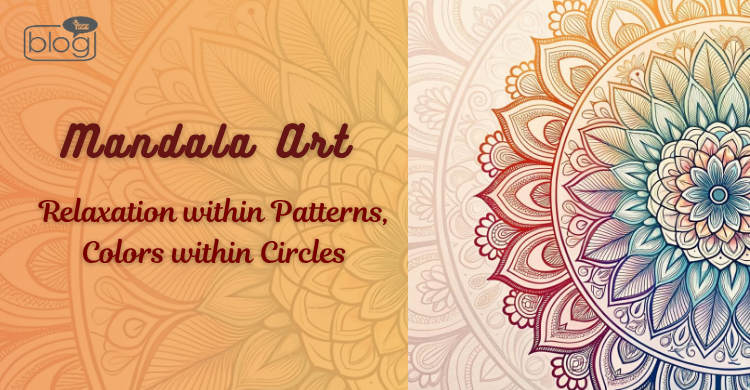
Have you ever observed yourself doodling different patterns in your notebook on a stressful day when nothing seems interesting, and you feel a little bit blue? Did you notice any changes after drawing repeated shapes and filling them with colors? Strangely enough, repetitive patterns, designs, and colors may reduce our stress, calm our minds, and we may find peace within the patterns. This relaxation is no coincidence; it is the magic of mandala art. It is far beyond a pretty design. Rather, it visualizes designers’ creative minds and imaginary world. Mandala not only represents the beauty of art, but also serves as a gateway to peace, calmness, and inner clarity.
Ancient Roots of Mandala Art
The word “mandala” originates from the ancient Indian language called Sanskrit, which means circle. It represents geometric patterns, circles, different shapes, and symbolic elements such as flowers, trees, birds, or jewels. These intricate patterns or designs initially start from a center point and then frequently radiate outwards. Mandalas symbolize the universe, nature and its elements, spirituality, the cycle of life, death, and rebirth. It also signifies the connection between the cosmos and the inner self.
At first, mandala art emerged as a form of meditation following the path of Hinduism and Buddhism. As the monks traveled through Asia, they brought about mandalas with the practice of creating these artworks. Later on, it proceeded through different countries like China, Korea, Japan, Tibet, India, and many more over the centuries.
Creation of a sand mandala can be considered a noteworthy example of the ancient practice of mandala art. Tibetan Monks used to create one type of temporary mandala using colorful sand. Once they created the sand mandala, they swept the sand in one motion. It reflects the human journey in this temporary world and the beauty of letting go. Besides this, it was an important part of religious practice and held a lot of spiritual significance. Ancient temple walls used to be decorated with mandala designs. Nowadays, Many people draw these for pleasure or decorative purposes, though it was once used as a tool to focus on meditation or prayer.
Types of Mandala Art
The most fascinating part of mandala art is its diversity. These designs can take endless forms according to different patterns and elements.
Nature-oriented Mandala – This type of mandala art represents the universe, nature, and its elements like flowers, leaves, stars, and waves in a specific arrangement. These draw inspiration from the natural world and the beauty of nature.
Sand Mandala – Tibetan Buddhist Monks used to create mandalas with colorful sand. After completing, they used to demolish the whole design. It symbolizes the temporary worldly life of a human being.
Healing Mandala – These mandalas have meditative value and are designed to find peace and calmness in the process. It also helps to hold focus on meditation.
Teaching Mandala – These mandalas served as educational tools by Monks and practitioners to teach concepts of religion or religious journey in Buddhism.
Why are Mandalas Relaxing?
From several scientific studies, Psychologists have found that coloring mandalas reduces stress and anxiety, calms the mind, and thus helps to improve concentration and regulate emotions. Now, the important question is- what makes mandala art so relaxing?
Therapeutic Value – Mandalas are widely used as a psychological therapy. People are suggested to draw patterns and apply colors to explore emotions and heal traumas.
Boosting Creativity – Mandala designs encourage thinking and imaginative creativity. The process of choosing shapes and suitable colors expresses creative practice among the artists.
Stress Relief – When we remain busy creating patterns and filling them with colors, we deeply concentrate on the whole process. As a result, we forget our daily life worries for a while, and thus it helps to reduce stress.
The trend of mandala art began in temples. The centuries have passed, and it has become popular in the modern generation. We don’t need to be an artist to get the benefits. The calming effect does not come with perfect drawing, but with the process of drawing. For design lovers, mandala art allows us to portray our imaginative world and foster our creativity.
To read more blogs like this, click here.
Writer
Samiha Fouzia
Intern, Content Writing Department
YSSE