
Have you ever thought about why teachers fail to draw students’ attention in spite of utilizing engaging teaching methods and advanced tools in the classroom? Maybe, we didn’t, but Abraham Harold Maslow, an American psychologist, noticed the fact that why we, human beings, lose motivation. He identified all the human needs and emphasized their fulfillment to retain motivation in both personal life and professional settings. He stated in his theory that our actions are significantly driven by motivation, and it comes with a sense of well-being and fulfillment.
Similarly, Maslow’s theory of needs can be applied in our classroom settings to look for the answer to the previous question. Yes, it is true that mixing and matching multiple teaching strategies can develop students’ understanding and use of relevant tools can enhance active engagement of the students in the classroom. However, their learning can be affected due to the absence of some basic physiological and psychological needs. Maslow categorized the needs sequentially and provided a guiding framework to understand why meeting the needs first will lead to the way of effective learning in the classroom.
Maslow’s Levels of Need
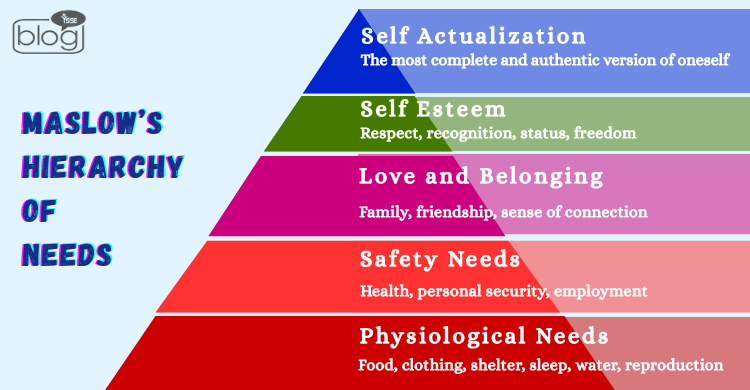
Maslow sequentially demonstrated the basic human needs in a pyramid comprising both physiological and psychological needs. It is arranged in a hierarchy with basic needs at the bottom, the creative one, ‘Self-actualization’, at the top, and the rest of all needs in between. It organizes human needs into 7 different levels-
- Physiological need: It is the lower part of the hierarchy, which includes all the fundamental needs that are essential for our life, such as food, drink, sleep, education, shelter, clothing, etc.
- Cognitive Development: Human beings are curious in nature. Their curiosity, inquisitiveness are the focus points of this level.
- Aesthetics: Humans are the worshipers of beauty. So, it not only includes personal beauty but also the beauty of nature and our surroundings.
- Safety needs: It involves predictability, order, and control, which ensure job security, financial security, security of life, and freedom.
- Love and Belongingness: As we are social beings, we expect mutual understanding and love from our loved ones. The key points of this need are love, trust, family, friendship, and intimacy.
- Self-esteem: It includes respect, recognition, appreciation of achievement, praise, and confidence.
- Self-actualization: It refers to the idea of realizing one’s full potential and utilizing it. This is the ultimate level where any person can make the best use of their creativity and problem-solving skills and promote lifelong learning.
Why does it matter?
Can you imagine solving any mathematical equation or practicing literature with a hungry stomach? Can an anxious student concentrate properly on the classroom lessons? The answer is “No” in both questions. A financially challenged and a financially affluent student do not face the same difficulties in life. Their access to quality education and learning differs with their family background and financial status. In that case, Maslow’s Hierarchy of Needs can assist us in addressing their basic physiological as well as psychological needs.
Students without basic needs often lack energy, enthusiasm, and concentration on their studies. Maslow’s pyramid can be the ladder by which teachers can diminish the barriers to effective learning and direct us to fulfill students’ needs. As a consequence of this, every learner will remain motivated and can utilize their full potential in the classroom.
Bangladeshi Classroom Context
A student enters a congested and crowded classroom with an empty stomach because his family can barely afford breakfast. As a result, he is to attend classes with a hungry mind. His classroom is not only crowded but also has cracked walls, benches, poor lighting, and ventilation system. Some of his friends disturb and bully him, and instead of being compassionate, his teacher scolds him for being inattentive in class. Even when he tries to overcome those barriers and achieve something good, all his efforts go in vain. He begins to doubt his merit for not being appreciated.
This story reflects all the challenges a student of Bangladesh faces in the classroom and demonstrates all the needs Maslow addressed in his theory. From the very beginning of the class, a student struggles with hunger, poor infrastructure, lack of safety and belonging, and absence of appreciation. As described in Maslow’s theory, these deficiencies hamper students’ concentration on studies, make the learning journey difficult, and thus hinder effective learning.
The process of learning starts with the fulfillment of needs, moves through classroom activities, and finishes with the construction of knowledge. In that instance, Maslow’s Hierarchy has emerged as a new dimension in the field of education as it implies that the purpose of education is not only cognitive development, but also a holistic development of the learners. Effective learning happens with appropriate teaching strategies alongside prioritizing and nurturing students’ needs before attaining learning outcomes.
To read more blogs like this, click here.
Writer
Samiha Fouzia
Intern, Content Writing Department
YSSE