
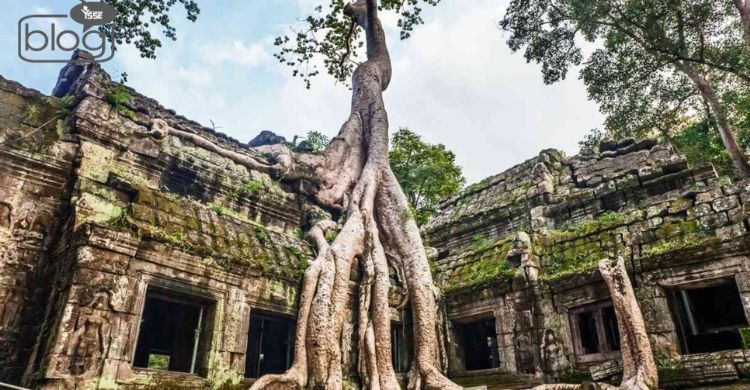
What comes to your mind when you think of lost civilizations? Destroyed walls of ancient buildings and buildings taken over by the nature, right? Well, if this is your thinking, then you’re not wrong. Remains of lost civilizations today mostly are these destroyed walls taken over by nature. Today, I’m going to tell you those tales of some lost civilizations of the world.
Since the beginning of the world till now, many great civilizations have been built. Over the course of time, many of those great civilizations got thrived, many got declined, while many of them got destroyed. Come, let’s learn about some.
The Mayan Civilization
Rose in the tropical lowlands of the present Guatemala nation, the Mayan empire was one of the most powerful civilizations of that age. Around sixth century CE, it reached its peak power and influence. The Mayans were great in agriculture, pottery, writings, calendars, and mathematics. Most of the great stone cities of Maya were abandoned by 900 CE. Archaeologists say that the reign of this great empire came to an end due to the ongoing war and climate changes that time.
The Khmer Empire
The Khmer empire rose on the other side of the world and spread across present Cambodia. One of the largest cities of Khmer was Angkor, with a vast system of roads and canals. Its population was more or less around one million people. The Khmer empire was at its peak in between 1000 and 1200 CE. Experts still couldn’t find any exact reason why this empire got lost. The remains of it are left on the hands of the relentless jungle.
The Indus Civilization
The Indus Civilization, also known as the Harappan civilization, was the largest among all other civilization having extended reign over parts of India, Pakistan and Afghanistan. It had a population as many as five million people. At its peak time, it built some of the world’s most impressive and remarkable architecture. It disappeared about 3000 years ago for reasons unknown.
Easter Island
Famous for the enormous stone heads that line its coastline, Easter Island was formerly home to a thriving Polynesian civilization that arrived there at around 700 CE. The inhabitants of it were skilled sea navigators who also displayed other noteworthy skills. Debates are there that the civilization got extinct because of the lack of its natural resources.
Çatalhöyük
Modern Turkey was once home to the world’s oldest cities, Çatalhöyük. It was part of a vast civilization that ruled between 9000 and 7000 years ago, and then, it suddenly disappeared. The hivelike design of the dwellings in Çatalhöyük made it special, which were built close to one another and reached via ladders and aerial walkways through holes in the roof. The people are long gone, but a wealth of artifacts describing their lives and customs were left behind.
The Mississippians
From about 700 CE until European contact and colonization, most of the American Southeast and mid-continent was inhabited by an agrarian civilization known as the Mississippians. Cahokia was one of their biggest cities which was close to the present-day Illinois town of Collinsville. Cahokia had a huge central plaza, substantial clay pyramids, and wooden structures that resembled stonehenge in shape and were used to chart the stars. As with other lost civilizations, experts still don’t know the exact reason that led to the gradual extinction of the Mississippians.
Tiwanaku
Western Bolivian Pre-Columbian civilization known as the Tiwanaku Empire had its center in the southern Lake Titicaca Basin. One of the most important Andean civilizations was Tiwanaku. It lasted from roughly 600 to 1000 AD and had an impact on modern-day Peru and Chile. The Akapana Pyramid, a rectangular enclosure known as the Kalasasaya, built of alternating towering stone columns and smaller rectangular blocks, and another enclosure known as the Palacio are among Tiwanaku’s most notable monuments. Tiwanaku ruled or significantly influenced a significant area of what is now eastern and southern Bolivia, northwestern Argentina, northern Chile, and southern Peru during its peak.
You will find thousands of civilizations of the ancient world that lost their existence over the course of time. Here are some of them that I tried to sum up.
Indeed, nothing is permanent in this world. These ancient civilizations of the world lost their existence and must have changed to fossils under the surface. Change is the only constant in life.
“Nothing endures but change.”
– Heraclitus
To read more blogs like this click here .
Writer
Abdullah Al Noman Khan
Intern Content Writer
YSSE