
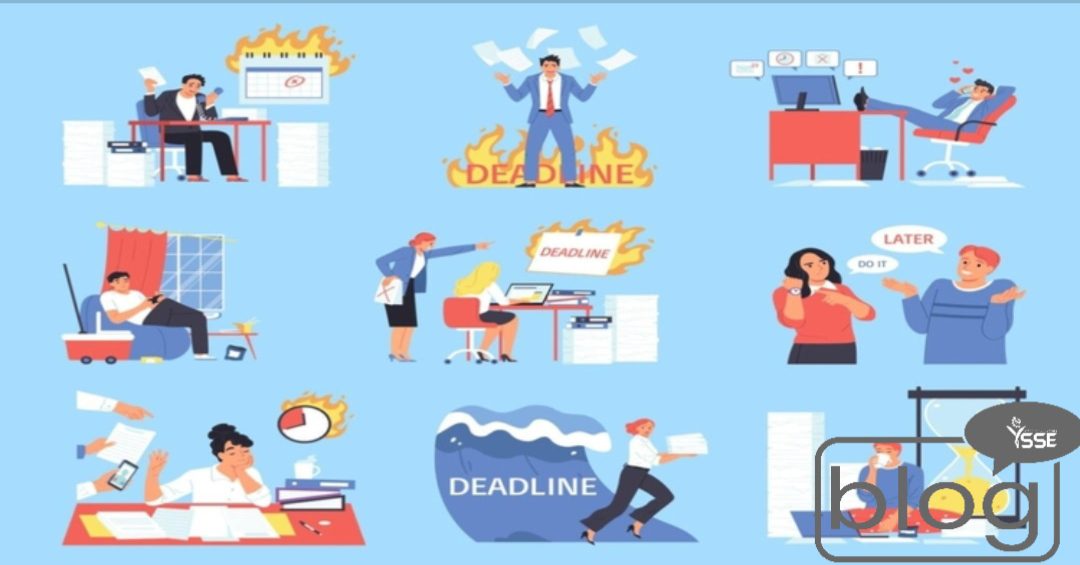
Have you ever been faced with an impending deadline and just couldn’t seem to get started? While you should be working, you’re scrolling social media instead of finishing the task that is due the next morning. You quickly realize that you haven’t written anything and the day is almost over. Then what do you do?
Let’s go through four of the most common reasons for procrastination and discuss strategies to overcome them.
The task seems difficult:
The task seems difficult, which is the main cause of procrastination. This can be avoided by breaking the task into smaller and easier steps. To write one chapter or page per day, for instance, instead of attempting to finish a book in a year. It often seems much easier to complete complex or difficult tasks by breaking them down into smaller subtasks. The next step is to choose which subtask you should work on first after determining the steps required to finish a task. You can do this using either the “eat the frog” method or the “snowball” method.
Starting with the simpler tasks and gradually working up to the more difficult ones is the snowball method. You gain confidence by doing the simpler tasks before moving on to the more difficult ones. On the other hand, the “eat the frog” approach is the complete opposite. There is no one best strategy; both the snowball method and the “eat the frog” method can be helpful. Try both methods and see which works best for you. The next step, no matter which strategy you select, is to “just start.”
Although it seems simple, for most individuals this is the most difficult step. One approach to get through this is to tell yourself that you just have to work for 5 minutes to start, which will ease the pressure and fear of the process.
There isn’t enough time to make progress on the task:
The next reason that people procrastinate is that they feel they don’t have enough time. If this is your reason for procrastinating, then the first thing is to realize that it is not true. Everybody finds time for the things that matter to them. If you haven’t scheduled it, it’s most likely because you haven’t given it priority. Your schedule should be a reflection of your priorities.
Making time for key activities like studying or exercising regularly will help them develop habits, which will make preventing procrastination that much easier. This is also a great time to put Parkinson’s Law to use, which states that “work expands to fill the time allotted for its completion.” Set a time limit for yourself and stick to it when completing a task or subtask.
You don’t have the energy:
The third reason why people procrastinate is a lack of energy to work on a task. To overcome this, you must take a look at your physical well-being. There are three foundations of health: sleep, nutrition, and exercise. When any of these are out of balance, you cannot function optimally. Although it may appear to be unrelated, prioritizing your health can have a big beneficial impact on your capacity to overcome procrastination.
When you feel good, you have more energy to do a task. Having said that, even with strong health habits, there may be days when you feel tired. There are some things you may do in these situations to raise your energy levels. To begin the task, taking a break is essential.
Something else is more interesting:
The final reason for procrastination is that there are simply more entertaining or fascinating ways to pass the time. Spending time with friends or watching a new Netflix series is more thrilling than writing an essay or studying for an exam. You need to make the task you’re trying to complete more appealing than the other options available to you to get the hard work done. The trick is to make your environment work with you. You want to establish a distraction-free environment where the only option is to work.
It’s important to remember that even the most productive people face procrastination. It is not an issue of always being motivated to complete tasks. Rather, it is the ability to complete tasks even when you do not want to.
To read more blogs #click here.
Writer,
Mehrin Khan
Intern, Content Writing Department
YSSE