
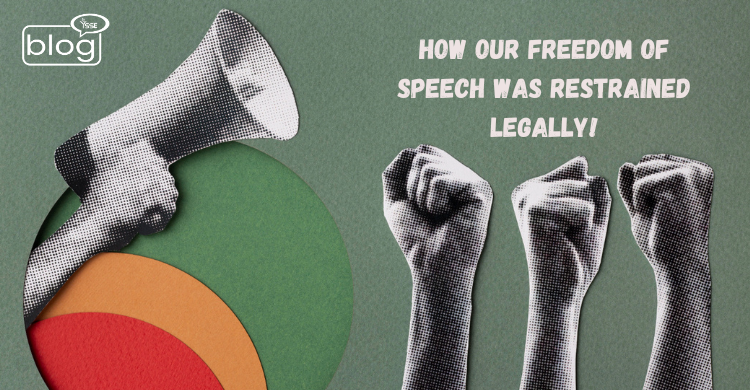
We have passed a very dark regime recently and now we are starting our new era of restoration with a lot of new hopes and dreams. We were chained by the dictatorship in so many ways. Freedom of speech and expression: one of the main aspects of human rights, one of the very important constitutional rights was taken away from us. And it was done by bounding us with a law.
There was an act called the Digital Security Act(DSA), 2018. This law was supposed to protect us from digital threats like online bullying, cyber crimes, hacking, stackings, etc. But like most of the laws, there were some vaguely described parts of the law that our ruler started to use against the people who raised their voices against the oppression.
Another act named Information and Communication Technology (ICT), 2009 had a provision that had already been used in favor of the oppressor government. The infamous Section 57 of that act made it into the act of 2018. A lot of human rights activists were convicted for using a non-specified section of the act. For example, an author and social activist author and social activist died in Bangladesh jail on February 25, 2021. He was detained for social media posts where he criticized the ruling government. Since then it has been used to target human rights activists and journalists.
Most of the cases were filed under section 57 of the ICT Act. Sub-section 1 of the act mentioned that any person publishes or transmits or causes to publish something fake, obscene, or defamatory material in electronic form and among the subjects something that causes to deteriorate law and order, mainly indicates activities or offenses that disturb the peace and goes against the public interest. The specific section of the act had provisions like if any person is responsible for publishing something fake, obscene, or defamatory material in an online form that may disturb the peace and go against the public interest, it will be an offense and hence punishable under the same law. The problem with this section is that the term public interest is not clarified specifically. So this was easily weaponized against the people who criticized the ruling party. Following the massive criticism over the misuse of the act in various quarters.
After that in the name of restoration came the DSA Act, the same kinds of provisions followed the new act. Maintaining public order was also used very broadly here. This act mentioned the same types of punishment for the related offenses as the previous act. Then came the Cyber Security Act(CSA), 2023 in the name of another restoration. But not much has changed. Section 57 was repealed but the penalties of the new act for most cases appeared to be kind of the same as before. Meaning all the issues tackled under Section 57 are still engraved in CSA but in an elaborate manner.
So, we can see that the oppressor government kinda legally bound our rights to express ourselves. But now those days are gone. A talk of reformation of this act is in progress as expected. We have been dreaming of a truly free country from the day we were freed from our oppressors. We cannot let another law with loopholes restrain us all over again. We must ensure civic participation in every possible way so that our opinions reach the people that we nominate to lead us.
To read more blogs, please click here.
Writer
Samiha Noshin Sampritee
Intern, Content Writing Department
YSSE