
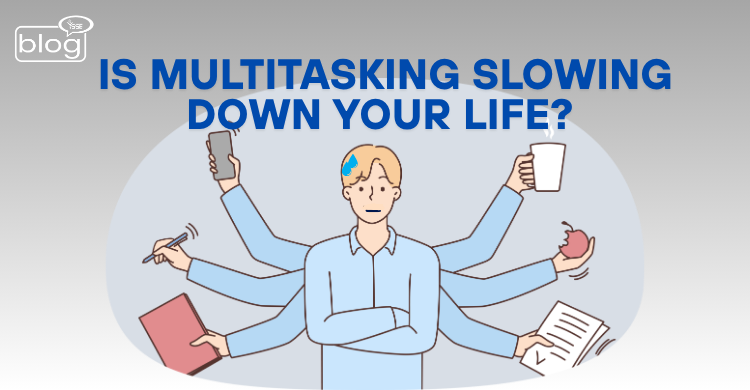
Today, the badge of honor is multitasking. We do it in meetings by reading email, surfing social media during dinner, and even trying to get work done while binge-watching Netflix. Work hard, twice the work in half the time. Reality? Multitasking is most likely more bad than good and perhaps even sneaking its way into your life and strangling it without you realizing it.
What Is Multitasking?
Multitasking is doing two or more things simultaneously, or switching between them extremely rapidly. Humans are misunderstanding it as productivity and thinking they would be completing their list sooner by accomplishing more in a sitting. But neuroscience disagrees.
The human brain is not able to multitask or perform a lot of the high-level thinking tasks simultaneously. What we think we are doing when multitasking is that our brain is switching between tasks very quickly, and it’s known as task switching. Task switching takes a lot of time and keeps mental resources on the shelf.
The Productivity Trap
Ironically enough, the reality is that multitasking does not increase productivity but actually decreases it. It has been found in a study conducted by Stanford University that most multitaskers are less productive and more distracted than other individuals who focus on one thing alone. While we attempt to do numerous things simultaneously, the quality of each work decreases.
It is slower, we are more in the wrong, and we spend time redoing what we thought we already did. Ultimately, what we provide as a shortcut in the first place ends up being a detour, and we waste precious time and energy.
The Hidden Cost: Mental Fatigue and Stress
The harm one inflicts upon one’s own mental well-being by constant multitasking is another threat. Regular task switching leaves one feeling mentally drained, more stressed, and even anxious. Cluttered minds, being present, decision-making, or even remembering something well, become harder.
This can be applied to daily life. You’re having dinner with family and friends, but you’re thinking of pending work or unread letters. Multitasking will make you seem to be staying abreast of life, but it keeps you out of it.
Traps That Multitasking Is Playing On You
- You start many and finish few.
- You’re mentally tired even if you’ve done little.
- You catch yourself repeating the same task.
- You keep making errors or missing small things.
- You have trouble maintaining concentration on a single task.
- You are “busy” but not necessarily getting much done.
If any of those ring true, your multitasking tendencies might be killing you.
Embracing Single-Tasking: The Smart Option
The reverse of multitasking is single-tasking, in which one completes one task at a time. It may be antiquated, but it is much more productive in terms of mental concentration, productivity, and enjoyment. The following are some tips to incorporate single-tasking in your life:
Time Block: Plan clean blocks of time for each assignment. Perform multiple tasks and avoid being distracted during that time frame.
Silence Notifications: Disable unneeded notifications while working or with family members.
Prioritize Tasks: Do the most important first. Never move forward unless finished or in a good spot or position to finish.
Take Breaks: Provide your brain with a recharge by taking a break between tasks. This captures maximum overall attention.
Existing in a society that encourages busyness has made us so busy that we often forget that reducing our pace can actually extend our lives. One at a time isn’t behind, it’s ahead. It’s present and engaged. When we cease and give full attention to something, we are more at peace, more imaginative, and more content. Sometimes, doing less gives us much more.
To read these types of blogs, click here.
Writer,
Umme Farhana Sumaiya
Intern, Content Writing Department
YSSE