
Law, justice, and social order are deeply connected and play a crucial role in maintaining a peaceful and functional society. Law refers to a system of rules created and enforced by the government to regulate human behavior.
These rules are designed to protect people’s rights, maintain order, and ensure fairness in society. In the present context, law plays an important role in controlling crime, resolving conflicts, protecting vulnerable groups, and ensuring equal opportunities for all citizens. Without law, society would fall into disorder, where injustice and inequality would dominate.
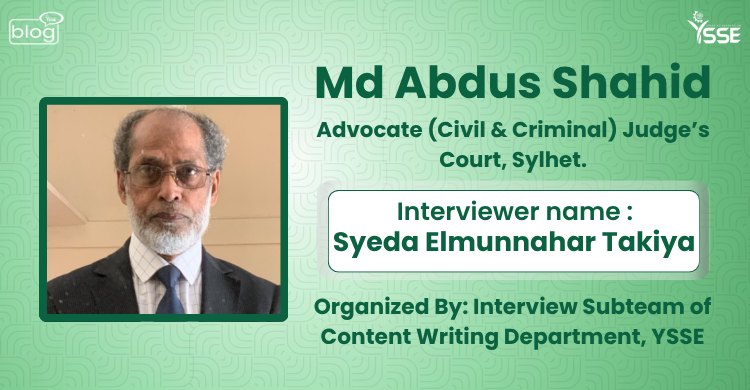
To explore this topic more deeply, the Interview & Podcast Sub-team of YSSE conducted an interview with an experienced legal professional, Md Abdus Shahid, who is an advocate by profession. He has long been involved in legal practice and has first hand experience in dealing with issues of justice, governance, and social challenges in Bangladesh. His insights help us better understand how law functions in real-life situations and how it contributes to building a just society.
Meaning of Justice
According to Md Abdus Shahid, justice is the foundation of any good society.
“Justice means making fair and unbiased decisions based on both legal principles and moral values”
It ensures that individuals receive their rights and that their life, property, and dignity are protected. Justice is not limited to court decisions; rather, it plays a wider role in maintaining peace and trust among people. When justice is absent, people begin to feel insecure, and social relationships weaken due to mistrust.
Importance of Social Order
He further explains that social order is essential for peaceful coexistence. Social order refers to a system where people follow certain rules, norms, and values that guide their behavior. It helps maintain harmony and prevents chaos and disorder. When social order is strong, communities function smoothly. However, when it breaks down, crime increases, injustice becomes common, and vulnerable groups suffer the most.
Rule of Law and Equality
The concept of the rule of law is another key element highlighted in the discussion. It means that everyone is equal before the law, and no one regardless of power or status is above it. The rule of law prevents the misuse of authority, ensures accountability, and protects citizens from arbitrary actions. It also helps build discipline and fairness within society.
Consequences of Ignoring Law
Md Abdus Shahid also points out the serious consequences when laws are not properly followed or enforced. In such situations, society becomes unstable, and stronger individuals or groups begin to dominate weaker ones. This leads to widespread injustice, fear, and a lack of trust among people. The poor and marginalized communities are often the worst affected in such conditions.
Role of Government and Citizens
He emphasizes that establishing justice is not the responsibility of the government alone. Citizens also have a vital role to play. People must respect and follow the law, promote fairness, and stand against injustice. Civil society organizations and social welfare groups contribute by raising awareness and advocating for human rights.
Laws and Social Challenges
Addressing social challenges, he notes that the government creates laws to tackle issues such as violence against women and child marriage. While these laws are important for protecting victims and punishing offenders, sometimes they clash with existing social customs and traditions. This creates debates about fairness and highlights the need for continuous legal reform and social awareness.
Role of Youth in Justice
Finally, he highlights the role of youth in building a just society. Young people have the energy and potential to bring positive change. By acting with honesty, raising awareness, and actively participating in social initiatives, they can help reduce injustice and strengthen the rule of law.
Overall, establishing justice, social order, and the rule of law requires a collective effort. It is not only about creating good laws but also about ensuring their proper implementation and encouraging responsible citizenship. As some legal anthropologists in Bangladesh suggest, there is often a gap between law and practice. Bridging this gap requires unity, awareness, honesty, and integrity from both the government and the people.
To read more, click here
Writer
Syeda Elmunnahar Takiya
Intern, Content Writing Department
YSSE