
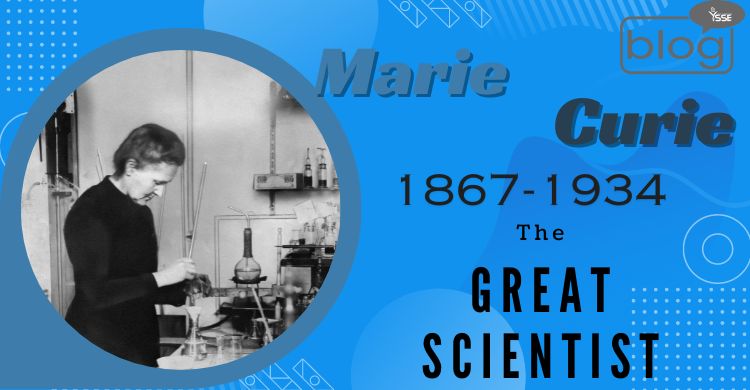
Few names stand out as brightly in the annals of scientific history as Marie Curie, the historian of science best renowned for her double Nobel Prize and for discovering radium and polonium. Maria Skłodowska, born in Warsaw, Poland in 1867, transcended gender stereotypes and became one of the most renowned scientists of all time. Marie Curie’s road to scientific glory is a story of tenacity, endurance, and determination, as well as significant discoveries.
Marie had an unquenchable curiosity and hunger for knowledge since she was very young. Despite several challenges, including limited educational possibilities for women at the time, she pursued her passion for science with steadfast determination. After overcoming financial difficulties and studying clandestinely, she relocated to Paris to continue her degree at the Sorbonne.
Marie met Pierre Curie in Paris, a fellow scientist who shared her enthusiasm and intelligence. Their collaboration would influence not only their personal lives but also the development of science as a whole. Together, they set out on a scientific expedition that would completely transform our knowledge of the basic characteristics of matter.
Marie Curie’s scientific journey manifests in numerous ways, including her revolutionary discoveries, her systematic approach to study, and her long-lasting influence on the domains of chemistry and physics.
First and foremost, Curie’s groundbreaking contributions to the realm of radioactivity are evidence of her extraordinary scientific talent. In 1898, Marie and her spouse Pierre Curie made the discoveries of two new elements: polonium and radium. She was the first woman to win the coveted Nobel Prize in Physics in 1903 for this discovery, which profoundly altered our understanding of the nature of matter.
Marie Curie’s accomplishments, however, did not stop there. She pursued her research with unmatched tenacity after Pierre’s untimely death in 1906. Her discovery of radium and polonium isolation techniques earned her a second Nobel Prize in Chemistry in 1911. She was the first—and as of right now, the only woman—to get Nobel Prizes in two distinct scientific domains as a result of this.
In addition to her achievements in science, Marie Curie’s humanitarian work during World War I solidified her reputation as an inspiration and symbol. She created transportable radiography devices, dubbed “Petites Curies,” to offer front-line wounded soldiers X-ray services. Her unshakable passion for using science for the advancement of society was illustrated by her unselfish dedication to easing human suffering. Marie Curie’s life is an example of the strength of desire, tenacity, and grit. Her extraordinary path from impoverished beginnings in Poland to the highest level of scientific achievement serves as an example to budding scientists and inventors across the globe. She not only revolutionized our understanding of the natural world but also cleared the path for upcoming generations of scientists to follow in her footsteps with her ground-breaking discoveries and unyielding dedication.
Marie Curie’s wise words, “Be less curious about people and more curious about ideas,” perfectly capture her commitment to the advancement of science. Curie’s ardent curiosity for the natural world propelled her throughout her successful career and resulted in several firsts in the science of radioactivity.
But Curie’s untimely death was ultimately caused by her unwavering dedication to her scientific endeavours. 66-year-old Curie was exposed to radiation on July 4, 1934, while working on radiological tests at a military hospital during World War I. It is ironic that the investigation of radioactivity, which she had invented, ended up being the reason behind her death.
This tragic irony highlights the delicate interplay between human vulnerability and scientific advancement. Although Curie’s revolutionary research transformed our knowledge of matter’s basic properties, it also put her at risk from radiation. Her passing is a sobering reminder of the dangers associated with scientific study and the need for safeguards.
Marie Curie’s outstanding contributions to science are demonstrated by her groundbreaking discoveries as well as her unwavering commitment to expanding our knowledge of the natural world. She is a true symbol of scientific achievement because of how her contributions to the domains of chemistry and physics have shaped and continue to affect scientific research and innovation.
To read more blogs,click here
Writer,
Taj Tania Meem
Intern,
Content Writing Department
YSSE