
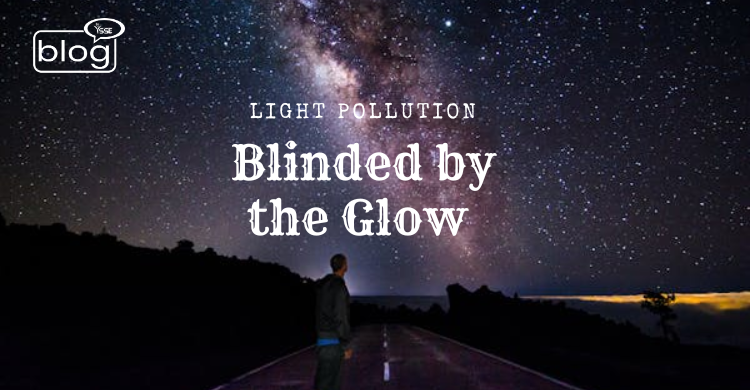
Have you ever pondered the disappearance of stars above us? Ever wondered why you no longer hear the chirping of nocturnal birds? The cause is light pollution. The term “light pollution” refers to the unwanted, excessive, or misdirected light that disturbs the natural balance between light and dark environments. Light pollution is mainly caused by human activities, especially the excessive usage of light at night. Light pollution is not as well-known as other pollutants brought on by human activity. A major problem in both the industrialized and developing worlds is light pollution. This may sound exciting that excessively illuminated cities are even visible from the ISS (International Space Station). However, this excessive illumination takes a heavy toll not only on our economy and power consumption but also causes the degradation of human health, wildlife, and ecosystems.
Light pollution can come in several forms:
- A light trespass occurs when a big, bright light trespasses an unintended area.
- Glare is an excessive amount of light that causes visual discomfort. Excessive amounts of light blur our vision.
- Clutter is the cluster of confusing, excessive groupings of light.
- The artificial illumination of the night sky is known as “sky glow.”
The negative impacts of light pollution are extensive. The research found that 23% of people worldwide are affected by skyglow, and 83% of people live in areas with light pollution. Sleep disturbance, headaches, tension, anxiety, and other health issues are caused by nocturnal light, which also disrupts the circadian cycle and prevents the melatonin hormone from being produced.
Artificial light is becoming an obstacle in the migration of animals like birds and sea turtles who are guided by moonlight. This results in an alteration of migratory birds and animal migration patterns, hunting patterns, habitats, and mating patterns. The nocturnal birds, like owls and hunter animals, are losing their ability to hunt and are getting confused by the glow of the night sky. Sea turtle hatchlings are getting lost due to the glow of the night sky. Light pollution has negative impacts on the ecosystem. For instance, many nightlights may have an impact on night-blooming flowers, which rely on nocturnal insects for pollination. The night sky has diverse impacts on insect reproduction and their instincts. But light pollution hurts these factors. In a study, it is seen that light pollution near water bodies prevents zooplankton from eating algae, which eventually results in algal bloom. During some recent studies, it has been seen that in big cities, the sleeping-waking pattern of birds is different from that of their countryside relatives, all because of the glow of the night sky.
All the excessive electric light we use to light up our cities uses energy. And this unnecessary use of lights causes energy inefficiency. Most of our power plants run on fossil fuels. When we use the lights 24×7, it consumes a huge amount of power, which eventually results in energy waste and economic loss. From an estimation, it is known that about one-fourth of power wastage is caused by lighting. Energy wastage leads to cost and carbon footprint waste.
Unlike the other forms of pollution, light pollution can be eradicated immediately. It is as simple as turning off the lights, shielding the street lights, reducing the use of indoor lights, starting to use energy-efficient LED bulbs, and avoiding using blue lights at night. The wavelength produced by the blue-tinted LED bulbs affects the ecosystem more than the yellow-tinted filter-installed bulbs. In the U.S., the National Audubon Society runs a program from San Francisco to New York called Lights Out, which encourages the cities to turn off the lights when migratory birds are passing through. According to a 2017 study, even the dimming of lights for 30 minutes can prevent migratory birds from fatal collisions.
The environment has a balance of dark and light. Whenever humans try to interrupt the environment’s pattern, it only brings destruction. The impacts of light pollution may not seem fatal, but eventually, it is harming our environment on a large scale in many aspects. Unlike other types of pollution, it is not irreversible or difficult to eliminate from the environment. Just by dimming the lights, this pollution can be removed from the environment.
To read these types of blogs, click here
Writer
Zabin Tasmin
Intern, Content Writing Department
YSSE