
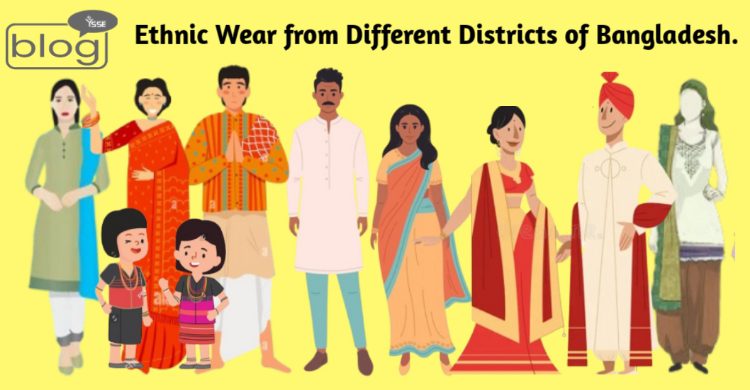
Every place has some local wear for its people. Ethnic wear depends on the people’s taste, their financial state, cultural heritage, climate and geography, social status, and identity.
As Bangladesh has 64 districts it has many different ethnic wears around the country.
Let’s look up some districts’ ethnic wear:
- Dhaka : Starting with the capital Dhaka, we have Dhakai Jamdani. It is made from fine cotton and silk. In the Mughal period from 1526 to 1707, the finest Jamdani was produced in Dacca, a Bengal state (now Dhaka, Bangladesh).
It is comfortable to wear in the tropical climate of Bangladesh. It is a symbol of aristocracy.
Both men and women were styling themselves with Jamdani back then but now only women wear it as a saree.
Nowadays women wear them for special occasions.
UNESCO has recognized Jamdani as the national heritage of Bangladesh.
- Chattogram : It is known for Panjabi and Fatua. Panjabi is a long tunic worn by men. But Fatua is a casual and comfortable outfit and is enhanced more with different designs and colors.
Most of them are made from cotton fabrics. After that, the lungi is very popular among men, it is worn as comfortable wear.
But, in villages, older men wear it for occasion purposes also.
Styling sense gets a bit different when it comes to rural areas like Bandarban, and Rangamati as these areas are surrounded by Indigenous People.
They have their local items of clothing like pinon, and dhuti which are very different from people of other areas of Chittagong.
- Rajshahi : In Rajshahi, people wear different clothing like Sari, lungi, kurta and pajama, Panjabi and Dhuti, Gamchha etc.
Sari is mostly worn by women, especially middle-aged women regularly. Men in Rajshahi wear kurta pajamas for special purposes and lungis for casual wear.
Gamcha is a special part of clothing, you will be amazed to know that famous designer Bibi Russell makes designer clothes from Gamchha, making a style statement.
- Khulna : Khulna is known for traditional handloom textiles like muslin, jamdani, and khadi etc.
People in Khulna wear embroidery clothes and attach different motifs in their clothes related to nature and maritime life. Khulna closer to the Sundarbans and the coastal areas influenced their style of sense.
- Sylhet : Riha is a traditional scarp in Sylhet that women wear, particularly in rural communities. Just like other districts they also have saree, lungi, Panjabi, salwar Kameez, etc.
- Tangail : Tangail is famous for Tangail Sari. It is also known for Tangail Tat Katan Silk, Karatia Tant Hat, Tangail Cotton Sarees. Tangail Tat Katan Silk is very vibrant in color whereas Tangail Cotton Sarees are simple in design and mostly worn for casual wear.
These are a specialty of various district people’s clothing styles but there are some clothes which are commonly worn in almost every district which is salwar Kamiz. Women wear it for casual wear, formal wear, and special occasions.
For special reasons like marriage nowadays many women choose lehenga over traditional saree. For men, they choose different clothes for different purposes.
For formal wear they choose a formal shirt and pants which are not local wear, and for various occasions they mostly choose Panjabi.
But for a special time, they choose sherwani which is embroidered clothes but in Dhaka nowadays men wear suit pants coats for special occasions.
To read more blogs like this, click here.
Writer
Adri Sen
Intern, Content Writing Department,
YSSE.