
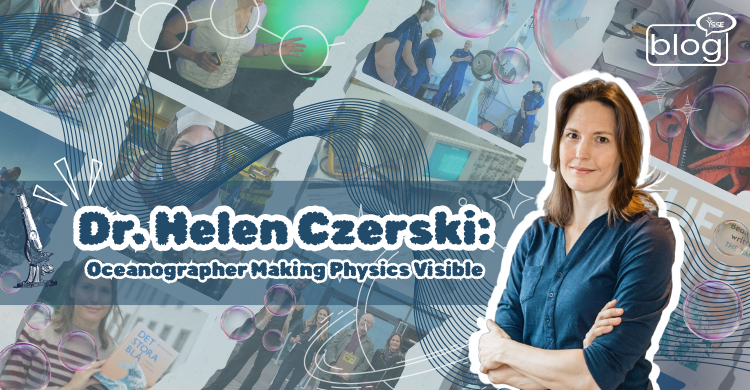
Even if we live in the modern era of science, we still think in the stereotypical way of science. A chemist deals with only chemicals, a physicist studies forces, a biologist studies life, and an oceanographer studies the vast ocean. It’s just the way that we find natural. But today, Dr. Helen Czerski, an oceanographer, broke that stereotypical way and told the story of the dynamics of the ocean through Physics. We see the ocean, tides, and waves; she sees the tune physics plays through these.
Helen Czerski, a British Physicist was born on November 1, 1978 in Manchester, England. As she grew up seeing the vicinity of canals, railways, and industries , the physical process made her curious. This led her to be a physicist. But she is not only a physicist, she is also a broadcaster, storyteller, and oceanographer. She studied Physics at Churchill College, Cambridge, and earned her Master’s degree. Later, she got her PhD in experimental explosives physics with high-speed photography. But she found Ocean rather interesting and realized that many of the theories of physics could be applied to it.
But how did she, a physicist, become an oceanographer? As she studied experimental explosive physics that required high-speed photography, she liked small things happening really quickly. And bubbles were just the right thing. Right after her PhD, to understand the ocean better, she went to work at the Scripps Institution of Oceanography because there was a guy who actually studied bubbles.
When she got into the lab and really looked at the ocean with a physicist’s eye, she learned that there is a bigger story there. There was a thing to study. Later, she also went to the Graduate School of Oceanography of Rhode Island. After gaining enough experience, she returned to the UK and started her own research. And that’s how she also became an oceanographer.
Helen started with tiny bubbles, and she calls herself a Bubble physicist. Though people often associate with bubbles while playing. But to her, these bubbles held so much meaning, almost like they were another whole universe. Once you learn about it, you will know how much influence it has. As the wave breaks onto the shore, bubbles form by trapping air, acting like tiny pistons. This later creates a spray, then a mist, and then forms a cloud. These clouds then regulate our weather by transmitting light. These bubbles also play a vital role in creating the sound underwater. She also showed how the sea breathes, connected the phenomena like currents, energy, and Thermohaline Circulation.
So interesting, right?
Helen’s discovery was a great feat. She wrote 2 books about it: Storm in a Teacup and The Blue Machine. She won a lot of awards for her books, such as the Premio ASIMOV award and, Wainwright Prize. Being a broadcaster, she hosted a lot of shows on the BBC like “Orbit: Earth’s Extraordinary Journey”, “The Secret Life of Sun”, “Dara Ó Briain’s Science Club”, and so many more. She is an all-rounder. She is literally the idol of our generation. She also taught us that we can do so much more rather than just learning whatever our academic major binds us.
You might say her discovery did not win any recognition. But it doesn’t really matter. We got to learn one more thing about our earth, our sea. Otherwise, let’s be real, who would have thought that those tiny bubbles did so much to our weather? In the era of science and technology, we speak so much of Einstein, Newton, Marie Curie, Darwin, and many more who shaped science as it is today. But how many of our current scientists do we know about who are reshaping the future? Helen Czersky’s discovery is also a valuable asset. Cause next time we see bubbles, we will not think of it as just a bubble.
To read more blogs like this, click here.
Writer
Ifraat Jahan Esha
Intern, Content Writing Department
YSSE